
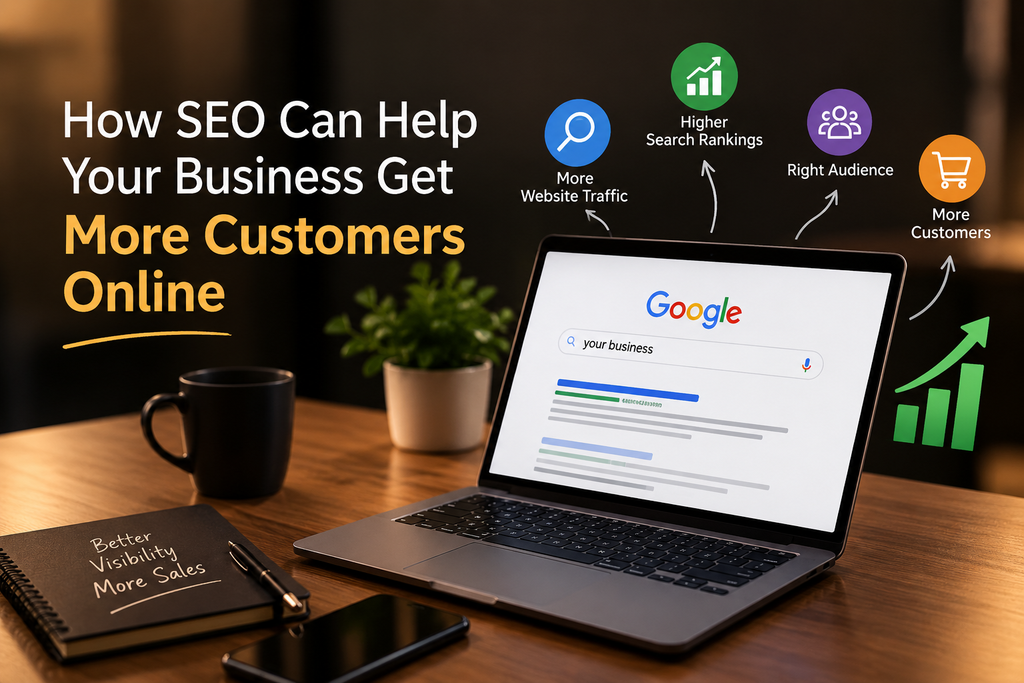
If you’re a business owner, your customers are probably already looking for you online — whether they know your name or not. When people type “good bakery near me” and “affordable web design services” into Google, if your website doesn’t come up, that customer will go straight to your competitor.This is where SEO (Search Engine Optimization) comes into play. This isn’t just a technical thing for developers to know — it’s one of the most practical, cost-effective ways to grow a business in 2025 and beyond.Let’s take a look at what SEO actually does for your business and why it should have a place in your marketing budget.
What SEO Really Means for Your Business
Search engine optimization means making your website easier for search engines to understand and rank — so that when someone searches for something relevant, your business appears on the search results page (SERP), not on page five. Good SEO is not just about satisfying Google’s algorithm. It’s all about giving people who visit your site a really good experience.
Here’s what a solid SEO strategy typically involves:
- Keyword research – finding the exact words and phrases your potential customers are typing into search engines, including long-tail keywords that show strong buying intent
- On-page optimization – refining your title tag, meta description, headers, and content so both users and search engines understand what the page is about
- Technical SEO – making sure your site has a clean XML sitemap, proper canonical tags, and no crawl errors that stop Google from indexing your pages
- Off-page SEO – building backlinks and social signals from other reputable sites, which boosts your domain authority
- Local SEO – optimizing your Google My Business listing and local citations so nearby customers can find you
- Content marketing – publishing content around your target keywords and search intent to draw in organic traffic over time
Why It Actually Moves the Needle
A lot of business owners assume paid ads are the fastest way to get customers, and for quick wins, they can be. But SEO plays a different, longer game — and it tends to pay off far more sustainably. Here’s why:
- It targets people who are already looking. Unlike interruptive advertising, SEO captures search intent — people actively searching for what you offer, which means higher conversion rate optimization potential.
- It builds credibility: Ranking high organically is a credibility signal. Most people trust organic listings more than paid listings, especially if your site has good E-A-T (expertise, authoritativeness, trustworthiness).
- It compounds over time. A blog post you write today can keep generating organic traffic for years, unlike an ad that stops the moment your budget runs out.
- It improves your whole website. Optimizing for search engine ranking also means improving page load speed, mobile-friendly design, and overall user experience (UX) — all things that make visitors more likely to stick around and buy.
The Elements That Actually Move Your Rankings
If you’re just starting out, don’t try to do everything at once. Focus on the fundamentals first:
- Site speed and mobile usability – Google just doesn’t rank slow sites well anymore, especially on mobile. And honestly, users won’t wait around either — if your site takes too long to load, they’re gone before it even finishes, and that hurts your click-through rate too.
- Content that matches what people are actually searching for – This one’s simple: write for the person reading it, not the algorithm. Figure out what your audience is really asking and answer that clearly, instead of cramming in keywords that make the writing feel unnatural.
- Internal linking and anchor text – Think of this as giving both your visitors and search engines a map. When your pages link to each other in a way that makes sense, people (and Google) can actually follow the story of your site instead of getting lost.
- Alt text and image optimization – It seems minor, but it does two things at once — makes your site more accessible to people using screen readers, and gives search engines a bit more context about what’s on the page.
- Schema markup – This is basically extra structured info you add behind the scenes so Google can show rich snippets — star ratings, prices, that kind of thing — right in the search results. It makes your listing stand out and tends to pull in more clicks.
- Watching what your competitors are doing – Not to copy them, but to notice what’s working in your space. It’s often the fastest way to spot gaps in your own content or keywords you haven’t thought to target yet.
- Actually using your analytics – Google Search Console and Google Analytics tell you the truth about what’s bringing people to your site. No point guessing when the data’s right there — use it to fine-tune your approach.
Don’t Ignore Voice Search and Local Intent
More customers are using voice assistants to search, especially for local businesses — “find a plumber near me” is a very different query pattern than typed searches. Optimizing for conversational, question-based phrases and keeping your local SEO details (address, hours, reviews) accurate and consistent across the web can make a real difference in foot traffic and calls, not just website visits.
The Bottom Line
Let’s be real — SEO takes time. If someone tells you they’ll get you to page one of Google in a week, run the other way. But if you’re willing to put in the work — fixing the technical stuff behind the scenes, writing content people actually want to read, earning genuine backlinks, and staying tuned in to what your customers are really typing into that search bar — you end up with something no amount of ad spend can replicate: a site that keeps pulling in customers month after month, all on its own, without you paying a rupee for every click.
Haven’t checked on your site’s SEO in a while? Start there.